Stevenson’s Samoan Political Involvement Club President Monica Hudson discussed Robert Louis Stevenson’s time in Samoa, focusing on his work “Footnote to History.” They explored Stevenson’s involvement in Samoan politics and his relationships with local leaders, as well as the challenges he faced due to his critical stance on colonial powers. The group discussion highlighted Stevenson’s complex views on Samoan culture and his attempts to write a history of the South Pacific, which his wife Fanny discouraged. The group also touched on Stevenson’s financial struggles and the costs associated with his Samoan lifestyle. Bruce Longstaff provided updates on his struggles with reading “The Great North Road,” a completed work by Stuart Campbell based on Stevenson’s unfinished novel, which Bruce found confusing due to its reorganized characters and unconventional narrative style.
Monica Hudson on RLS’s History of South Pacific
The Silverado Squatters – RLS Zoom Salon
Quick recap
The main focus of the Salon was a detailed exploration of Robert Louis Stevenson’s travels through California, particularly his experiences in Napa Valley and the Silverado area, including discussions about his writing style, historical observations, and interactions with local residents. The conversation ended with a review of historical photographs and a discussion about organizing future field trips to local museums and historical sites in the region. On 22 May 1880, RLS and Fanny Stevenson left for their honeymoon in the Napa Valley region of California (accompanied by Fanny’s son Lloyd Osbourne). Stevenson later described their travels in TheSilverado Squatters. https://robert-louis-stevenson.org/works/the-silverado-squatters-1884/
Stevenson’s Silverado and Napa History
The group discussed Robert Louis Stevenson’s “Silverado Journal,” focusing on his portrayal of the Hansen family and Jewish peddlers in the American South and West. Mimi S, as a Napa native, found the descriptions of the area and its people interesting, particularly the historical context of the Toll House and Mount Saint Helena. The conversation touched on the geological nature of the area and the existence of a book by Ken Stanton about Mount Saint Helena.
Stevenson’s Travel Writing and Hiking
The group discussed Robert Louis Stevenson’s travel writing, noting its conversational tone and how it differs from his earlier, more literary works. They explored Stevenson’s observations about Scottish Jews and their financial habits, particularly in relation to a character named Kelmore. Roger shared information about a book on Mount Saint Helena and recommended two hiking guides for the Napa Valley area. The conversation concluded with a brief discussion about potential hiking plans in Silverado, with Monica suggesting an overnight trip, though Roger warned about the steep trails.
Honeymoon in a Primitive Cabin
The group discussed Fanny’s experiences during her honeymoon in a primitive cabin, noting the lack of modern comforts and the presence of poison oak. They explored how Stevenson remembered the landscape, including the stars and fog, and how Fanny adapted to the rugged environment. The conversation touched on Fanny’s resilience and ability to make the best of their situation, as well as her background in mining camps, which may have prepared her for such conditions.
Napa Wine Industry’s Early Challenges
The group discussed the early history of the Napa Valley wine industry, focusing on Jacob Schram’s experiences and the challenges faced by early winemakers. They explored how winemakers in the 1880s had to experiment with different grape varieties and planting locations due to the valley’s complex microclimates. The discussion also covered the impact of phylloxera, a vine disease that devastated European vineyards, and how American rootstocks were used to combat the pest. The conversation concluded with a brief mention of Schramsberg Vineyards, one of the oldest (1862) wineries in Napa Valley, and the eventual success of California wines in international competitions.
Stevenson’s Napa Valley Observations
The group discussed Robert Louis Stevenson’s observations of Napa Valley and Calistoga in the 1870s. They explored Stevenson’s description of a book called “From Palace to Hovel” by Daniel Kerwin, which provided a social commentary on London’s contrasts between wealth and poverty. The discussion concluded with insights about Calistoga’s development as a spa resort destination, with Roger explaining that it was already well-known in Stevenson’s time for its springs, wine industry, and as a fashionable retreat for San Francisco residents.
Mountain Mining and Squatter Conflicts
The group discussed the historical mining activities in the mountains, particularly focusing on cinnabar mining for mercury and the resulting red soil. They explored how mining operations were quickly abandoned, and buildings were often moved or dismantled when mining camps closed. The conversation also covered the complex situation involving squatters, including Louie and Fanny, and the complications around mining claims and ownership, with particular attention to the Hansens’ claim and the arrival of city owners when the lease expired.
Stevenson’s Napa Valley Travels
The group discussed Stevenson’s travels and the historical significance of Napa Valley, including the role of Chinese labor in wine cave digging and the presence of a historical Chinatown. They explored Stevenson’s route, noting that while he didn’t mention the navigable Napa River for shipping, the train was available for travel from South Vallejo to Napa and Calistoga. The discussion also covered Stevenson’s observations about grain shipping to England and the decline of South Vallejo, with Roger explaining the historical context of flour mills and transportation connections in the region.
Historical Photographs and Museum Planning
Roger presented images of the Star Mills in South Vallejo, including a ship crossing Carquinez Strait and the Palace Hotel, as well as photographs of Calistoga and Brandon’s resort. The group expressed interest in organizing a future field trip to the Sharpstein Museum in Calistoga, which contains a Stevenson exhibit and diorama, and Monica mentioned potential coordination with Napa County Landmarks and the County Historical Society.
RLS Zoom Salon with Trenton Olsen
As guest speaker of the RLS Club of Monterey Trenton Olsen held a literary salon focusing on Robert Louis Stevenson’s life, works, and legacy, with particular emphasis on his time in Saranac Lake and the preservation efforts at the Stevenson Cottage Museum. Trenton, a college professor and Stevenson scholar, shared his research on Stevenson’s essays and discussed plans for upcoming events, including a festival celebrating Stevenson’s 175th birthday and the 100th anniversary of the Stevenson Society of America purchasing Baker Cottage. The group also explored various Stevenson-related locations, including the Stevenson House in Monterey and the historic ship Equator, while discussing ways to support and promote Stevenson’s enduring influence.
While Robert Louis Stevenson is best remembered now for Treasure Island and Dr. Jekyll and Mr. Hyde, his personal essays may well be his best work. Recently compiled for the first time in a single volume, Stevenson’s essays outline his remarkable life story with playful humor, profound insight, and emotional force. Learn why the essays Stevenson wrote during his stay in a tuberculosis sanatorium in upstate New York were so pivotal for his life, career, and legacy and why the Robert Louis Stevenson Cottage Museum—the world’s first site dedicated to RLS—needs saving.
Robin’s power point provided information about Fanny and the times she lived. Included are paintings and artifacts related to Robert Louis Stevenson recently acquired by Terry Trotter from a collector in Hawaii.
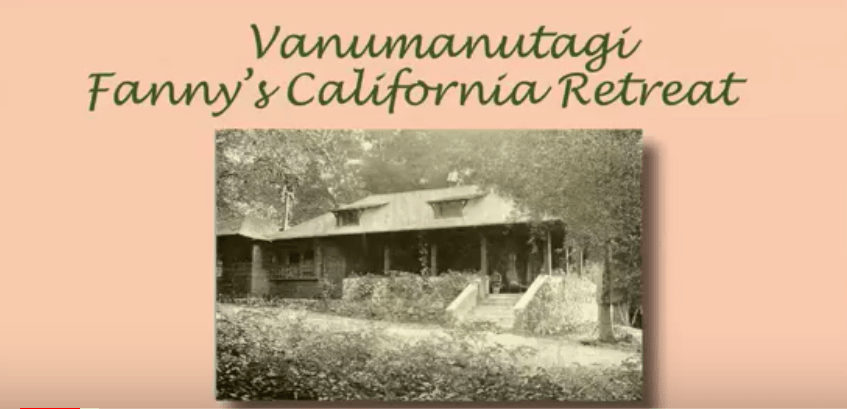
Club member Robin Chapman presents her research of the California property purchased by Fanny Osbourne Stevenson after the death of her husband. She named the place Vanumanutagi, Samoan for “vale of the singing birds”.
Many of the photos in the presentation were taken in the early 1900s by Louis Sanchez, Fanny’s nephew, and other photos were taken in the early 2000s by RLS Club members on a visit. These rare images are part of the Stevenson archives collection at the Monterey Public Library.
Robin Chapman is a journalist and historian, a native Californian, living on the coast in El Granada.
Next time in Pacific Grove, you’re invited to stop by Trotter Galleries on Forest Avenue. You’d be amazed by his display of the Stevenson’s, Steinbeck, and other celebrities.
 The Robert Louis Stevenson Club of Monterey